Air conditioners have become a basic household appliance in India. Rising temperatures, longer summers, and urban living make cooling a daily requirement rather than a luxury. Homes, offices, shops, hospitals, and even vehicles depend on air conditioning to maintain comfort.
However, an air conditioner consumes a large amount of electricity. This makes energy efficiency a major concern for buyers. To solve this problem, the Indian government introduced a star rating system. This system helps consumers understand how much power an air conditioner uses.
Most buyers get confused between 3 star and 5 star air conditioners. Both options look similar, and both provide cooling. Yet their long-term impact on electricity bills differs significantly.
This article explains the difference in a simple and practical way. It helps you choose the right AC based on usage, budget, and long-term savings.
What Does Star Rating Mean in an Air Conditioner?
Star rating shows how energy efficient an air conditioner is. A higher star rating means lower electricity consumption for the same level of cooling.
The Bureau of Energy Efficiency (BEE) under the Government of India assigns these ratings. Every air conditioner sold in India must carry a BEE energy label. This label allows buyers to compare different models easily.
A 1 star AC consumes the most electricity. A 5 star AC consumes the least. The difference becomes noticeable when the AC runs for many hours daily. Star ratings help consumers reduce electricity bills and energy wastage. They also support environmental protection by lowering power demand.
Understanding the BEE Energy Label
The BEE label appears as a rectangular sticker on the AC unit. It shows the star rating clearly at the top. The label also displays important technical details.
One of the most important values on the label is ISEER. ISEER stands for Indian Seasonal Energy Efficiency Ratio. It measures how efficiently an AC performs across different temperature conditions in India.
A higher ISEER value indicates better efficiency. A 5 star AC always has a higher ISEER value than a 3 star AC of the same capacity. Buyers should always compare both star rating and ISEER before making a decision.
Why Star Rating Matters in Daily Use?
Air conditioners do not consume electricity at a fixed rate. Power usage changes with room size, outdoor temperature, insulation, and usage hours. When an AC runs for short durations, the difference between 3 star and 5 star models remains small. When an AC runs for long hours every day, the difference becomes large.
For example, if you use an AC for 8 to 10 hours daily during summer, a 5 star AC can save a significant amount of electricity each month. Over several years, these savings often exceed the extra cost paid during purchase.
How Energy Efficiency Is Calculated?
Energy efficiency depends on how much heat the AC removes from the room compared to the electricity it consumes. Manufacturers measure cooling capacity in British Thermal Units. They measure power consumption in watts. ISEER comes from dividing total cooling output by total electricity usage across a season.
This calculation reflects real-world usage better than older methods. It helps buyers understand long-term performance rather than peak performance alone. A higher ISEER means the AC delivers more cooling with less electricity.
Does a Higher Star Rating Increase the AC Price?
Yes, a higher star rating increases the initial price. A 5 star AC costs more than a 3 star AC. Manufacturers use better compressors, advanced inverter technology, and improved heat exchangers to reduce power usage. These components raise production costs.
However, the higher purchase price does not mean higher overall cost. Electricity savings balance the price difference over time. Buyers who focus only on the purchase price often ignore long-term expenses.
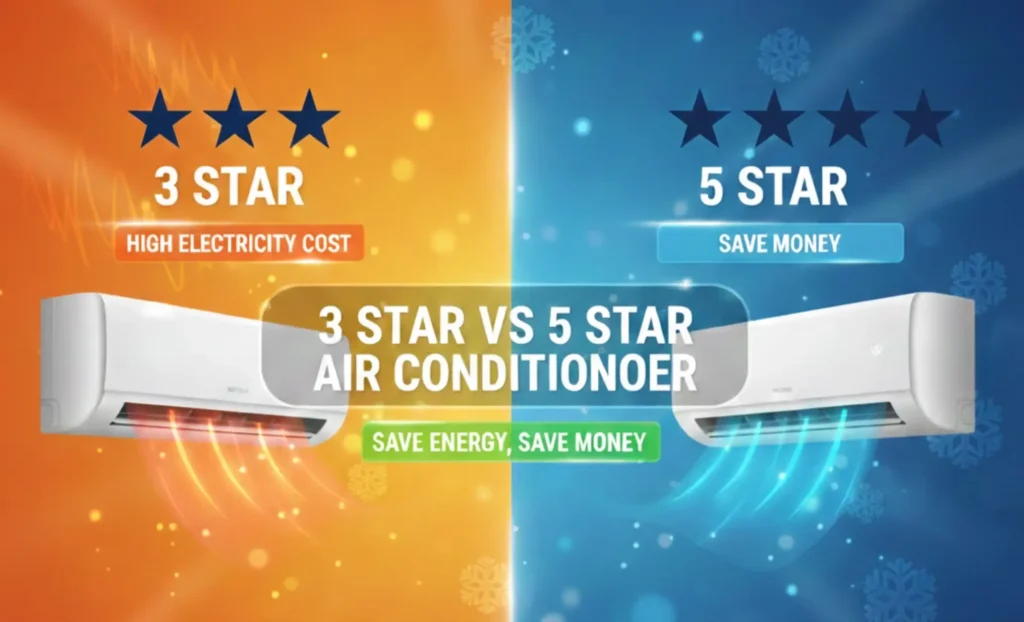
3 Star vs 5 Star Air Conditioner: Key Differences
| 3 Star Air Conditioner | 5 Star Air Conditioner |
| A 3 star air conditioner costs less initially. | A 5 star air conditioner costs more upfront. |
| It suits buyers who use ACs for a few months each year. | It consumes less power and delivers stable cooling. |
| It consumes more electricity per hour compared to a 5 star model. | It suits homes where the AC runs daily for long hours. |
The cooling performance feels similar in both models. The main difference appears in electricity bills.
Impact on Electricity Bills
Electricity cost remains the biggest expense during an AC’s lifetime. A 5 star AC can save 20 to 30 percent electricity compared to a 3 star AC of the same capacity. The exact saving depends on usage patterns and local electricity rates.
If you live in a city with high electricity tariffs, savings increase further. Over five to seven years, electricity savings often exceed the initial price difference between the two models.
Which AC Is Better for Short and Long-Term Use?
A 3 star AC works well for short-term or seasonal use. If you use an AC only during peak summer months or for a few hours daily, the extra cost of a 5 star AC may not recover quickly. For guest rooms, rental homes, or occasional use, a 3 star AC remains a practical option.
A 5 star AC works best for long-term and heavy use. If your AC runs daily for several hours, especially in hot and humid regions, a 5 star model offers better value. Homes with work-from-home setups benefit greatly from energy-efficient ACs.
Effect of Star Rating Over Time and Environmental Impact
Star ratings remain valid for a limited period. BEE revises standards every few years. Older AC models may drop in star rating under new norms.
However, a 5 star AC maintains higher efficiency even after standard updates. It does not fall below the performance level of a 3 star AC for many years. This makes a 5 star AC more future-proof.
Air conditioners contribute to higher electricity demand. This increases fossil fuel usage and carbon emissions. Energy-efficient ACs reduce power consumption. This lowers environmental impact and supports sustainable living. Choosing a 5 star AC helps reduce energy waste without compromising comfort.
Maintenance, Performance, and the 4 Star Middle Option
A 5 star air conditioner often comes with advanced inverter technology. The compressor adjusts its speed based on cooling demand. This reduces constant on-off cycles. Lower strain improves durability. Parts last longer. Maintenance costs stay lower over time.
A 3 star AC can perform well but may need more frequent servicing if used for long hours. Heavy daily use increases wear and tear. Maintenance expenses can rise in the long run.
A 4 star AC sits between these two options. It offers a balance between cost and efficiency. The purchase price stays lower than a 5 star AC. Electricity savings remain close. In many cases, the monthly bill difference between a 4 star and a 5 star AC stays minimal.
If your budget feels tight but daily usage remains high, a 4 star AC can work as a practical middle choice. It delivers good performance without the higher upfront cost of a 5 star model.
Final Verdict: How to Choose the Right Star Rating for You
| Feature | 3 Star AC | 3 Star AC |
| Price | Lower | Higher |
| Power use | Higher | Lower |
| Best for | Seasonal use | Daily use |
You should consider three factors before buying an AC. First, analyze daily usage hours. Second, consider electricity tariffs in your area. Third, evaluate long-term plans for your home. If usage remains low, choose a 3 star AC. If usage remains high, invest in a 5 star AC.
There is no one-size-fits-all answer. A 3 star AC suits limited and seasonal usage. It costs less initially and performs well for short durations. A 5 star AC suits heavy and long-term usage. It costs more at purchase but saves money every month. If you plan to use your AC daily and for many years, a 5 star air conditioner becomes the smarter choice.
Read More: Top 5 Best AC in India (2025) – Split AC Buying Guide
Frequently Asked Questions
Yes, a 5 star AC is worth the extra cost if you use the air conditioner daily or for long hours. It consumes less electricity and reduces monthly power bills over time.
A 3 star AC consumes more electricity than a 5 star model. It is suitable for limited or seasonal use, such as a few months in summer.
Star rating mainly affects energy efficiency, not cooling speed. Both 3 star and 5 star ACs can cool well if capacity and installation are correct.
A 5 star AC is better for long-term use because it offers lower power consumption, better efficiency, and savings on electricity bills over the years.
Yes, a 3 star AC is a good choice for users with limited usage, smaller budgets, or those who use AC only during peak summer months.
About the Author
Team Suggested creates simple and honest buying guides to help people make better choices. We test products, compare them and explain everything in easy words. Our goal is to save your time and help you pick the right product without confusion.